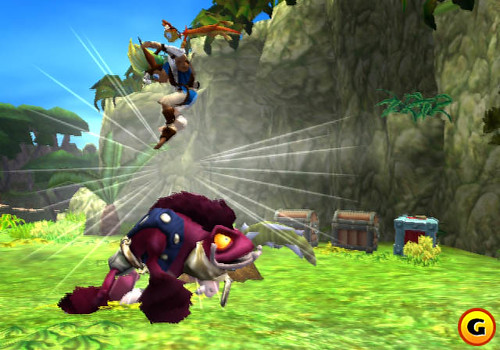
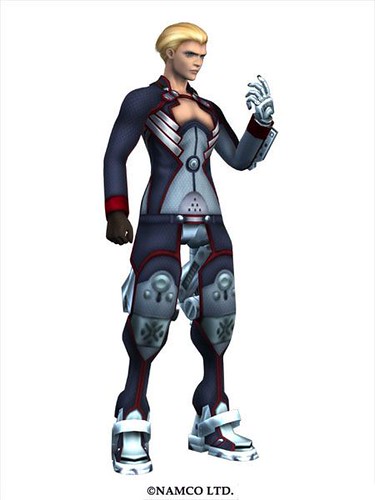
Seamless loading of a massive map is the major hallmark of this 2001 release. In most respects a fairly typical platformer, with a set amount of health that never increases, the only "power-ups" being new colors of eco (an energy source with different effects depending on the type), and some driving sequences, Jak and Daxter still garnered overwhelmingly positive reviews. While there was nothing especially innovative in the gameplay, story, or characters, the classic elements of a silent protagonist, obnoxious sidekick, and standard jumping and collecting puzzles merged together to create a wonderful, light-hearted, and fantastically fun game.
The ever-silent Jak and his best friend, Daxter, have disobeyed orders—as teenagers tend to do—and gone out to Misty Island. After witnessing a gathering of Lurkers and being attacked by a guard, Daxter is knocked into a pool of dark eco and transformed into a little orange critter dubbed an ottsel (half otter, half weasel). Samos, the Green Sage, tells them that they must travel across the continent to the Dark Sage in order to have Daxter's condition reversed. Trouble is, there's an awful lot of Lurkers between their village and the Dark Sage...
Images:
The titular duo
Samos, pontificating at length
Keira: Samos' daughter and mechanic extraordinaire
Hanging around the seaside
Spinning through the jungle
Fighting a Lurker
A little dance of victory
The game trailer
Thursday, January 24, 2008


Monday, January 7, 2008
Xenosaga
This massive, three-part game (Der Wille zur Macht, 2003; Jenseits von Gut und Böse, 2005; Also sprach Zarathustra, 2006—North American release dates) bears a number of similarities to its spiritual predecessor, Xenogears. Although many of the creators were the same, the company changed, and so the concepts were revisited in a new light without directly connecting the two. The changes continued in the saga, however, as any number of people involved in the creation changed from episode to episode, resulting in occasionally inconsistant character design and some fogginess of overall plot. The conversion from Japan to North America also brought changes in some of the scenes: censored for blood or violence in order to reduce the rating. Also prone to change were the voice actors, resulting in at least one character going from a light tenor to a mellow baritone. Retaining from Xenogears the themes of gnosticism, philosophy, and psychology, Xenosaga heavily references Nietzsche and Jung in everything from the game titles to character names. Much like Xenogears, Xenosaga features long cinematic scenes that occasionally interfere with the feeling of gameplay, but fans tend to overlook the flaws in favor of the incredibly complex story and character relationships. Fortunately, there's an in-game database to help keep people, places, events, and terminology straight. It's a testament to the intricacies of the games that the database is necessary.
Major characters
Shion Uzuki: Lead developer for Vector Industries on project KOS-MOS, a brilliant young woman. I II III
Jin Uzuki: Shion's estranged elder brother. A gifted swordsman, but aimless in life. Professions have included medical doctor and bookstore owner. IIa IIb III
KOS-MOS: An experimental battle android with a fierce loyalty to Shion that trancends her programming. I II III
chaos: A mysterious young man with a gentle disposition that belies his abilities. I IIa IIb III
Jr.: Apparently a boy of about twelve, captain of one of the galaxy's most powerful battleships, and evident successor to the prestigious Kukai Foundation. I II III
MOMO: A prototype Realian—an artificial human—in the form of a young girl. I II III
Ziggy: Zigguraut 8, a cyborg charged with MOMO's protection. His price for taking the mission was to be allowed to die. I II III
Margulis: A fierce opponent and swordsman on par with Jin. They have a shared history.
Albedo: A white-haired, virtually immortal psychopath with a fixation on Jr.
Gaignun Kukai: The titular head of the Kukai Foundation. His relationship to Jr. is not immediately apparent, although the similarity of appearance is marked.
Broken down by individual game, all beyond the first entry will contain spoilers for the previous installments:
Xenosaga Episode I: Der Wille zur Macht
Sometime this century, an archeological expedition in Kenya uncovers a golden monolith known as a Zohar, with catastrophic effect. Fast forward a few millenia, to where humans populate over 500,000 planets, but no one knows the location of their original home, now known as Lost Jerusalem.
About fourteen years previously, Shion's home planet of Miltia was ravaged by malfunctioning combat Realians and lost in space-time following the emergence of the Gnosis—extra-dimensional creatures with the ability to crystalize organic life on contact. KOS-MOS is designed to combat Gnosis, but she's untested and unable to repel the attack on their ship which happened to be transporting a Zohar. Shion, KOS-MOS, and a couple of others are the only survivors, picked up by a salvage ship owned by the Kukai Foundation, of which chaos—retained for his ability to dissolve Gnosis with a touch—is a crew member. Along the way they pick up Ziggy and MOMO, the latter having been rescued from Margulis and wanted for the data encoded in her. When Jr.'s battleship is framed for the destruction of Shion's transport in an effort to claim MOMO, they must all work together to get themselves in the clear. Pursued and opposed by any number of factions that want possession of both the Zohar and MOMO, this is, to say the least, no simple task.
Xenosaga Episode II: Jenseits von Gut und Böse
Continuing immediately after the events of the first game, this episode features largely around Jr.'s history. Jin Uzuki is introduced in the beginning in a flashback of the destruction of Miltia, where he meets chaos (physically the same as he is fourteen years later) and a Realian named Canaan, who are trying to find the source of the planet's troubles. Jin manages to give Margulis his distinctive scar at this point, Canaan stores encoded information in his brain until it can be extracted later, and they stumble over and rescue a couple of injured boys: Nigredo and Rubedo, A.K.A. Gaignun Kukai and Jr. In the present time, familial discord abounds as Rubedo and Albedo fight each other over the information still locked inside MOMO, Shion holds Jin to blame for the death of their parents, and chaos is revealed to have a connection to one of the galaxy's major players.
Xenosaga Episode III: Also sprach Zarathustra
A year after the death of Albedo, Shion has left Vector and is working with an underground group of saboteurs known as Scientia. While looking for information about her father's possible involvement in the destruction of Miltia she's called upon by old friends. A section of Lost Jerusalem has appeared, floating in space, but was pulled into an anomaly along with the ship that rescued Shion the previous year. In an effort to save them, Shion and the others finally discover the whole truth behind the destruction of Miltia, the existance of the Gnosis, and the path of destruction that humanity has been nudged along for thousands of years.
Major characters
Shion Uzuki: Lead developer for Vector Industries on project KOS-MOS, a brilliant young woman. I II III
Jin Uzuki: Shion's estranged elder brother. A gifted swordsman, but aimless in life. Professions have included medical doctor and bookstore owner. IIa IIb III
KOS-MOS: An experimental battle android with a fierce loyalty to Shion that trancends her programming. I II III
chaos: A mysterious young man with a gentle disposition that belies his abilities. I IIa IIb III
Jr.: Apparently a boy of about twelve, captain of one of the galaxy's most powerful battleships, and evident successor to the prestigious Kukai Foundation. I II III
MOMO: A prototype Realian—an artificial human—in the form of a young girl. I II III
Ziggy: Zigguraut 8, a cyborg charged with MOMO's protection. His price for taking the mission was to be allowed to die. I II III
Margulis: A fierce opponent and swordsman on par with Jin. They have a shared history.
Albedo: A white-haired, virtually immortal psychopath with a fixation on Jr.
Gaignun Kukai: The titular head of the Kukai Foundation. His relationship to Jr. is not immediately apparent, although the similarity of appearance is marked.
Broken down by individual game, all beyond the first entry will contain spoilers for the previous installments:
Xenosaga Episode I: Der Wille zur Macht
Sometime this century, an archeological expedition in Kenya uncovers a golden monolith known as a Zohar, with catastrophic effect. Fast forward a few millenia, to where humans populate over 500,000 planets, but no one knows the location of their original home, now known as Lost Jerusalem.
About fourteen years previously, Shion's home planet of Miltia was ravaged by malfunctioning combat Realians and lost in space-time following the emergence of the Gnosis—extra-dimensional creatures with the ability to crystalize organic life on contact. KOS-MOS is designed to combat Gnosis, but she's untested and unable to repel the attack on their ship which happened to be transporting a Zohar. Shion, KOS-MOS, and a couple of others are the only survivors, picked up by a salvage ship owned by the Kukai Foundation, of which chaos—retained for his ability to dissolve Gnosis with a touch—is a crew member. Along the way they pick up Ziggy and MOMO, the latter having been rescued from Margulis and wanted for the data encoded in her. When Jr.'s battleship is framed for the destruction of Shion's transport in an effort to claim MOMO, they must all work together to get themselves in the clear. Pursued and opposed by any number of factions that want possession of both the Zohar and MOMO, this is, to say the least, no simple task.
Xenosaga Episode II: Jenseits von Gut und Böse
Continuing immediately after the events of the first game, this episode features largely around Jr.'s history. Jin Uzuki is introduced in the beginning in a flashback of the destruction of Miltia, where he meets chaos (physically the same as he is fourteen years later) and a Realian named Canaan, who are trying to find the source of the planet's troubles. Jin manages to give Margulis his distinctive scar at this point, Canaan stores encoded information in his brain until it can be extracted later, and they stumble over and rescue a couple of injured boys: Nigredo and Rubedo, A.K.A. Gaignun Kukai and Jr. In the present time, familial discord abounds as Rubedo and Albedo fight each other over the information still locked inside MOMO, Shion holds Jin to blame for the death of their parents, and chaos is revealed to have a connection to one of the galaxy's major players.
Xenosaga Episode III: Also sprach Zarathustra
A year after the death of Albedo, Shion has left Vector and is working with an underground group of saboteurs known as Scientia. While looking for information about her father's possible involvement in the destruction of Miltia she's called upon by old friends. A section of Lost Jerusalem has appeared, floating in space, but was pulled into an anomaly along with the ship that rescued Shion the previous year. In an effort to save them, Shion and the others finally discover the whole truth behind the destruction of Miltia, the existance of the Gnosis, and the path of destruction that humanity has been nudged along for thousands of years.
Thursday, January 3, 2008
Xenogears
Philosophical, psychological, and religious themes pervade 1998's Xenogears, enough so that a decade later the intricacies and overall meaning of the game are still hotly debated. On the surface it's a confusing mesh of destruction, hatred, and giant robots. Underneath that is a confusing mesh of love, death, betrayal, psychosis, self-determination, and 10,000 years of machinations and plotting. The game mechanics are subject to debate, as the innovative mix of semi-turn-based battle and combination attacks are juxtaposed against the unlikely addition of platforming elements, leading to some extremely unusual jumping puzzles prone to interruption in mid-leap by random battle. Equally subject to debate are the long cutscenes, some lasting upwards of twenty minutes at a time. While the story unfolds and the characters are explored, it can be quite frustrating to play for five minutes, watch ten minutes, play ten seconds, watch fifteen minutes, play thirty minutes, watch twenty minutes, etc. Also of concern to some is the disparity of graphics, with less than stellar in-game animation occasionally being supplanted by hand-drawn anime sequences. Regardless of how they may fall on these minor issues, fans of the game universally applaud the twisted depths of the story, with references ranging from Gnosticism to Soylent Green and the vagaries of Dissociative Identity Disorder and Freudian psychology.
The nations of Aveh and Kislev have been at war for time beyond memory. Kislev had developed an edge until the appearance of a new fighting force, Gebler, put Aveh back on top. The war literally drops into the middle of a quiet border town and the resulting destruction forces Fei—a young man with no memories prior to three years previous when he was taken into the village with severe injuries—to depart for the world at large on the advice of his friend and town doctor, Citan. Fei meets Elly, a Gebler soldier, for the first time in a series of life-changing meetings before falling in with Bart, the deposed heir of Aveh. Reluctantly joining Bart's insurrection, Fei is gradually exposed to the contrived forces behind the war, the feuding religious sects of the Ethos and Nisan, thousands of years of history that had been deliberately buried, and a handful of strange people who alternately want to make him stronger, empower his enemies, or just kill him for existing. The matter of warring nations falls by the wayside as it becomes apparent that the issue at hand is the survival of the human race.
Images:
Your first glimpse of Fei
The improbably-haired Fei against the backdrop of his burning town
Meeting Elly
A recurring image
Bartholomew Fatima (Bart)
Left to right: Bart, Citan, Fei, and Billy—an Ethos warrior priest
The Nisan cathedral
Grahf, who has a habit of empowering Fei's enemies
Id, who has a habit of killing entire cities for amusement
The seemingly irrelevant opening sequence
In-game graphics demo: Citan, Billy, and Elly fight Id
The nations of Aveh and Kislev have been at war for time beyond memory. Kislev had developed an edge until the appearance of a new fighting force, Gebler, put Aveh back on top. The war literally drops into the middle of a quiet border town and the resulting destruction forces Fei—a young man with no memories prior to three years previous when he was taken into the village with severe injuries—to depart for the world at large on the advice of his friend and town doctor, Citan. Fei meets Elly, a Gebler soldier, for the first time in a series of life-changing meetings before falling in with Bart, the deposed heir of Aveh. Reluctantly joining Bart's insurrection, Fei is gradually exposed to the contrived forces behind the war, the feuding religious sects of the Ethos and Nisan, thousands of years of history that had been deliberately buried, and a handful of strange people who alternately want to make him stronger, empower his enemies, or just kill him for existing. The matter of warring nations falls by the wayside as it becomes apparent that the issue at hand is the survival of the human race.
Images:
Your first glimpse of Fei
The improbably-haired Fei against the backdrop of his burning town
Meeting Elly
A recurring image
Bartholomew Fatima (Bart)
Left to right: Bart, Citan, Fei, and Billy—an Ethos warrior priest
The Nisan cathedral
Grahf, who has a habit of empowering Fei's enemies
Id, who has a habit of killing entire cities for amusement
The seemingly irrelevant opening sequence
In-game graphics demo: Citan, Billy, and Elly fight Id
Wednesday, December 19, 2007
The Legend of Zelda: The Wind Waker
The first Zelda for the GameCube in 2002 (2003 outside of Japan) met with mixed reviews. While the gameplay and story were largely praised, there were complaints about the graphical style and the amount of time spent traveling through the enormous world. The cartoony, cel-shaded animation and bright colors lent Wind Waker the appearance of a childlike game which turned off adults who had grown with the series, and it took some time to come to terms with the surprisingly dark storyline behind the cheerful exterior. The name of the game—as well as its musical theme—comes from a conductor's baton that has power over the wind and, among other purposes, is instrumental in your ability to travel.
Many, many years after Ocarina of Time, the world is now a far-flung mass of islands separated by huge swathes of ocean. Link is a boy who's grown up on an island that tells the legend of the Hero of Time and who dress their boys in green when they come of age in order to inspire them with the ancient Hero's courage. When the day comes for Link to receive his green clothing, a giant bird kidnaps his sister, Aryll. With the help of the pirate girl, Tetra, Link gives chase and finds that Ganon has been kidnapping girls in an attempt to find Zelda. Overpowered, Link embarks on a massive quest to find the Master Sword once used by the Hero of Time, restore it to its former power, defeat Ganon, and save the world.
Images:
Link and Aryll
A sad Link waves goodbye while Tetra waits
Phantom Ganon
Plowing the waves
Conducting the wind
Slinking along a cliff face
A rather grainy Zelda
Many, many years after Ocarina of Time, the world is now a far-flung mass of islands separated by huge swathes of ocean. Link is a boy who's grown up on an island that tells the legend of the Hero of Time and who dress their boys in green when they come of age in order to inspire them with the ancient Hero's courage. When the day comes for Link to receive his green clothing, a giant bird kidnaps his sister, Aryll. With the help of the pirate girl, Tetra, Link gives chase and finds that Ganon has been kidnapping girls in an attempt to find Zelda. Overpowered, Link embarks on a massive quest to find the Master Sword once used by the Hero of Time, restore it to its former power, defeat Ganon, and save the world.
Images:
Link and Aryll
A sad Link waves goodbye while Tetra waits
Phantom Ganon
Plowing the waves
Conducting the wind
Slinking along a cliff face
A rather grainy Zelda
Saturday, December 8, 2007
The Legend of Zelda: Majora's Mask
In a rare move, a direct sequel to Ocarina of Time was released in 2000. In an even rarer move, a Zelda game was issued without a Zelda. Featuring the same Link and Epona from its predecessor, everything else is changed when they inadvertently ride into a parallel world. There are three major aspects to Majora's Mask: time, music, and masks. Unlike Ocarina's time travel, Mask relies on a constant timer and a fixed three-day period. Many of the songs from Ocarina are reused, as well as a number of new ones. Masks, which were a small side-quest in Ocarina, take the forefront in Mask (as evidenced by the title) allowing you to perform special tasks, enhance abilities, and even change form by wearing them.
Link is at a loss following his previous exploits. While wandering in the forest he's accosted and loses his horse. After chasing down the thief he's transformed by magic and left, stranded, in a strange, alternate reality. In return for help in resuming his human form, Link agrees to retrieve Majora's Mask for a traveling mask salesman, an ancient and powerful artifact that was stolen by the same person that attacked Link. There's only three days until the Masked thief calls the moon out of its orbit, so the race is on!
Images:
Deku Link is baffled
Goron Link is massive
Jamming with Zora Link
Transforming has a price
Very scary Oni Link—as a collectible figurine!
The opening movie and very early gameplay
Link is at a loss following his previous exploits. While wandering in the forest he's accosted and loses his horse. After chasing down the thief he's transformed by magic and left, stranded, in a strange, alternate reality. In return for help in resuming his human form, Link agrees to retrieve Majora's Mask for a traveling mask salesman, an ancient and powerful artifact that was stolen by the same person that attacked Link. There's only three days until the Masked thief calls the moon out of its orbit, so the race is on!
Images:
Deku Link is baffled
Goron Link is massive
Jamming with Zora Link
Transforming has a price
Very scary Oni Link—as a collectible figurine!
The opening movie and very early gameplay
Subscribe to:
Posts (Atom)